Saturday, January 21, 2023

Police negligence in Paras Shah murder case

When someone's loved one dies, his heirs are like broken bones, especially the parents. 


At this time, the parents and family members of Syed Paras Shah, who was killed in a mysterious manner in Hyderabad, are also going through the same situation. He was killed in his own house.  The police is hesitatant and failed to arrest the murderer.  Who will take actions against bandits?

 Pars Shah will be ordinary in the eyes of anyone, but the sophisticated and intelligent class of Sindh considers him special, because he is the son of that great personality, who has a great name in the field of Sindhi literature and broadcasting and even today if anything.  Go back to the past and focus on the mind that a powerful voice and a beautiful face like Syed Makan Shah Rizvi will be in front of everyone, who is currently lying in bed with a serious illness. When, it has been told that his son Paras was brutally murdered, what would be his mental condition?  Or when the dead body of his young son came in front of his mother, what agony would she have gone through?  That's why we say that parents die alive in such incidents. The video on social media makes everyone cry, in which Syed Pars Shah's mother cries over his death, but unfortunately no one helps them.  As a result, his sister and famous artist Sahar Shah Rizvi has to go out on the streets for his brother along with his family members and well wishers.

In the murder case of Paras Shah, who was killed in the jurisdiction of Bhittai Nagar police station of Qasimabad, the police's recklessness can be gauged from the fact that only those evidences were not collected from the place of death, which would have been the biggest leads.  It would have been understandable if the police officers of the police station of a backward area would have done so, but this is the police of Hyderabad, the second largest city of Sindh, which has to be investigated in a modern way.  The police say that there is no evidence of beatings on Pars Shah in the medical report, but the whole media is witnessing the blood flowed at the place where the body was found.  

 We regret that the police of Bhittai Nagar police station of Hyderabad have been showing irresponsibility in the murder case of Pars Shah since the first day, which is a sad and condemnable act.  By this time, the killers should have been arrested and their families should have been arrested, but from his silence, it seems that all the police officers from the bottom to the top do not realize what their responsibilities are!  Therefore, instead of appealing to them, we will request the IG Sindh to conduct a full investigation into the murder case of Paras  

Wednesday, June 1, 2022

ایم این اے چوہدری فقیر


لاہور ہائیکورٹ نے ایم این اے چوہدری فقیر کیخلاف الیکشن پٹیشن کا فیصلہ سنا دیا

لاہور: عدالت نے این اے 162 سے چوہدری فقیر کو نااہل قرار دینے کی استدعا مسترد کر دی
لاہور:2021 میں تحریک انصاف کی عائشہ نزیر نے الیکشن ٹریبونل سے رجوع کیا تھا
لاہور: جسٹس عاصم حفیظ پر مشتمل ڈویژنل بینچ نے مختصر فیصلہ سنا دیا
لاہور:ایم این اے چوہدری محمد فقیر کیجانب سے, بیریسٹر چوہدری حسنین پیش ہوئے
لاہور:عائشہ نزیر نے کاغزات نامزدگی میں نامکمل اثاثوں کو بنیاد بنا کر رجوع کیا
لاہور: عدالت نے درخواست گزار کا اعتراض مسترد کرتے ہوئے ایم این اے چوہدری فقیر کو بحال رکھا ہے,

Thursday, May 26, 2022

Pakistan's diplomatic efforts at Doha


By Dr Noorjahan

Pakistan's efforts in countering terrorism in the region is exemplary. Since, Afghan turmoi India has always tried to promote terrorism in Pakistan and Afghanistan. It is not alarming to see that the United States (US) media and its think tanks are criticizing Pakistan for the affairs of Afghanistan. Different think tanks including the United States Institute of Peace (USIP) are criticizing Pakistan for its failures in Afghanistan. This propaganda is nothing new and there is no need to worry about it. It was quite normal and I was expecting it a long ago even before the fall of Kabul at the hands of the Taliban. It is a reality that the Taliban defeated a superpower of this century with very few resources in their hands.

It wasn’t surprising for me when I read the criticism of the US think tank on Pakistan in the ongoing scenario of Afghanistan. Just remember the pictures that went viral on social media when the Taliban took over Kabul last year. The Taliban fighters were seen in ordinary dresses while a US soldier was dressed up in a proper military uniform with the complete gear of war. There was a huge difference in the cost between what a Taliban fighter was wearing and what a US soldier had. The US was spending billions of dollars in Afghanistan with a huge deployment of soldiers there. But, what happened in Afghanistan? History has witnessed that the Taliban defeated all the western powers with very limited resources. So, the reaction of these think tanks is quite normal because they lost a war here even after spending billions of dollars.

It was quite obvious that the western media will blame Pakistan for its failure in Afghanistan. Now, they are trying to damage the repute of Pakistan through their negative propaganda and putting the onus on us. Attempts are being made by the western world to hold Pakistan responsible for the Afghan fiasco. But the story is altogether different and every sane mind believes that Pakistan is the country that always played its role in bringing peace and stability to Afghanistan. Pakistan is an important and responsible regional player and it knows its worth too. Just have a look at the maiden visit of Pakistan’s new Foreign Minister to the United States. He was warmly welcomed there because the US knows very well the significance of Pakistan in the region. It was Pakistan that played the key role in Doha Talks that took place between the US and the Afghan Taliban. Pakistan prepared and convinced the Afghan Taliban to sit with the US at the negotiating table which ultimately paved the way for the US exit from the Afghan land. It is also a matter of fact that US Special Representative Zalmay Khalilzad first used to land in Islamabad before going to Kabul. He was an eyewitness to the Doha Talks and therefore he was very well aware of Pakistan’s role in signing that historical document.

(The writer is Karachi based Post Doctorate who believes in freedom of expression, a freelance columnist, entrepreneur and social activist).

Wednesday, May 25, 2022

Why Pakistan Blamed for US Failures in Afghanistan!


By Dr Noorjahan

US being a military superpower failed to win the Afghanistan war as there were fundamental strategic problems that resulted in the present circumstances. The US was sure of winning the 20 years long war but smoothly taking over most of the Afghan soil and falling of quick Afghan government by the Taliban was not expected. There was a huge criticism seen on President Joe Biden’s decision on the end of military presence and withdrawal of logistics.

When I read the criticism of the US think tank on Pakistan in the ongoing scenario of Afghanistan. Just remember the pictures that went viral on social media when the Taliban took over Kabul last year. The Taliban fighters were seen in ordinary dresses while a US soldier was dressed up in a proper military uniform with the complete gear of war. There was a huge difference in the cost between what a Taliban fighter was wearing and what a US soldier had. The US was spending billions of dollars in Afghanistan with a huge deployment of soldiers there. But, what happened in Afghanistan? History has witnessed that the Taliban defeated all the western powers with very limited resources. So, the reaction of these think tanks is quite normal because they lost a war here even after spending billions of dollars.

It was quite obvious that the western media will blame Pakistan for its failure in Afghanistan. Now, they are trying to damage the repute of Pakistan through their negative propaganda and putting the onus on us. Attempts are being made by the western world to hold Pakistan responsible for the Afghan fiasco. But the story is altogether different and every sane mind believes that Pakistan is the country that always played its role in bringing peace and stability to Afghanistan. Pakistan is an important and responsible regional player and it knows its worth too. Just have a look at the maiden visit of Pakistan’s new Foreign Minister to the United States. He was warmly welcomed there because the US knows very well the significance of Pakistan in the region. It was Pakistan that played the key role in Doha Talks that took place between the US and the Afghan Taliban. Pakistan prepared and convinced the Afghan Taliban to sit with the US at the negotiating table which ultimately paved the way for the US exit from the Afghan land. It is also a matter of fact that US Special Representative Zalmay Khalilzad first used to land in Islamabad before going to Kabul. He was an eyewitness to the Doha Talks and therefore he was very well aware of Pakistan’s role in signing that historical document.

Pakistan paid a heavy cost of this war on terror that had severely hit this region. We sacrificed our soldiers, our mothers lost their children and our economy was shattered due to this war. It will be remembered in world history that our nation showed great resilience in bringing peace to the region. Our Generals fought on the front lines in the difficult mountainous terrains to defeat the hidden enemy but never compromised on the principles. Many proxies were fighting on this toughest battlefield including India only to harm Pakistan. India did a huge investment in Afghanistan only in the hatred of Pakistan but still, India was the biggest loser in this whole saga of Afghanistan. When the Taliban took over Kabul, the staff of the Indian embassy fled in the darkness of night in utter embarrassment. It was a humiliating defeat for India in the region.

Afghanistan has a great history of empires where Great Britain and the Soviet Union have fallen. Taliban have firm faith in Allah and their unshakable emaan led to this victory. The criticism of the US’s decision is valid as the decision was stemmed from the approach of military seizuring of international territory to fight extremist ideologies and movements that were wrong. The political dialogue was considered by most leaders more effective in the place of using military force. Initially, it was seen that the US’s intervention in Iraq and Afghanistan was justified to control and eliminate the serious national security threats of weapons of mass destruction and Al-Qaeda. But with time, after fulfilling the initial desired aim, it was changed into a long-term approach for preventing future threats from these countries. It was planned to provide security and stability to both nations in establishing the governments in their respective countries.

Pakistan and Afghanistan share a long history and a border spanning hundreds of kilometres. The people of Pakistan and Afghanistan also share a close bond knitted with a rich legacy, culture and civilization. There are hundreds of people who cross the border between the two countries on daily basis. A large number of Afghan refugees are residing in Pakistan for decades which shows the hospitality of Pakistan towards its neighbours. The Afghan government alone is unable to run the education and health sectors after the withdrawal of international forces and the stoppage of funds.

It is need of the hour that the international community should step forward to help the Afghan community just on humanitarian grounds. Earlier, Afghan surprised millions of people by defeating the western powers in their land and now they are also surprising the western powers by respecting basic human rights.Instead of blaming Pakistan, the western powers should engage with the Taliban and appreciate the peace efforts of Pakistan. Pakistan is playing a positive role in Afghanistan based on the principle of humanity but it is being portrayed negatively by the spoilers and miscreants.

The writer is Karachi based Post Doctorate who believes in freedom of expression, a freelance columnist, entrepreneur and social activist.


Tuesday, January 1, 2019

Sinkholes, hottest day and a billion trees: Pakistan’s climate scorecard in 2018

By Nida Mujahid Hussain


The year 2018 did not come with glad tidings for Pakistan — a country, which according to 2018 Global Climate Risk Index report, ranks among top 10 countries most susceptible to climate change.

From ferocious heat waves to water woes, Pakistan needs to work urgently to combat the challenges ahead such as mass migration, loss of lives and livelihood, damage to the economy and crops.

Pakistan lost $382 million due to climate change
Between 1998 to 2017, Pakistan lost $3,826 million battling climate change issues, according to the report, and more than 10,000 human lives.

In order to mitigate the issue of greenhouse gas emissions, Pakistan would need $40 billion in funds, according to the Asian Development Bank.

Hottest day in April in Nawabshah

Consecutive heatwaves were witnessed in 2018's harsh summer/ file photo
This year, Nawabshah in Sindh witnessed the hottest day recorded on earth during April, as temperature soared to 50.2° Celsius. Several people reportedly suffered from heat-related dizziness and fainting.

Lahore records 214 mm rains, the heaviest in 38 years
In July, Punjab capital city, Lahore, recorded 214 millimetres (8.4 inches) of rain within a single day, the heaviest shower it has had in over 38 years. The torrential rain killed eight people, inundated areas and left many stranded. Two large sinkholes also appeared on the main thoroughfares of the city, 20ft deep and 200ft wide.

Karachi heatwaves
Not one, not two, but five heatwaves spells lashed Karachi, with highest temperature recorded as 45°C in May. The city faced an extended heatwave when the mercury reached 44°C for four to five days. Interior Sindh cities, Mohenjo Daro witnessed 50°C while in other cities, including Shaheed Benazirabad, Larkana, Dadu, Jacobabad, Lasbella, Sibbi, and Bahawalnagar the mercury went up to 49°C.

Water scarcity and the dam initiative

Pakistan to likely run dry by 2025/ file photo
Official projections show that Pakistan, whose population has increased fivefold since 1960 to over 207 million, will run dry by 2025. The country will be facing an absolute scarcity of water with less than 500 cubic metres available per person.

Following the emergence of the news, the Chief Justice of Pakistan Saqib Nisar launched a campaign to raise funds for the construction of two large water dams.

Election year, party manifestos
This year’s election was somewhat different. One departure from the norm was the talk of environment. The Pakistan Tehreek-e-Insaaf, which went on to form government, placed special importance on the need to save the environment in its party’s manifesto.

Since Imran Khan has been elected prime minister, he has rolled out several initiatives to increase Pakistan’s green-cover, such as the Clean and Green Pakistan drive and the Billion Tree Tsunami campaign.

Fighting smog

Due to the onslaught of smog during winters, Pakistan government ordered the closure of brick kilns for 70 days, starting October/ file photo
Due to the onslaught of smog during winters, the provincial government ordered the closure of brick kilns for 70 days, starting October till December 31.

Pakistanis among 800 million at risk of Global Warming: WB
The World Bank in a report had stated that 800 million South Asians were to face dire living conditions due to climate change, if greenhouse gas emissions were not reduced. The report said that the hotspots for climatic deterioration included six countries of the region.

( https://www.geo.tv/latest/223341-sinkholes-hottest-day-and-a-billion-trees-pakistans-climate-scorecard-in-2018 )

Wednesday, December 13, 2017

‘Teachers play vital role in character building of students’

QUETTA: The role of teachers is most important in character building of students for achieving lasting peace, tranquility, promotion of human rights and resolution of religious, political conflicts.
Addressing a training workshop titled “Insaniyt, Ikhliaqiyat and Shariyyat in Pakistan,” representatives of civil society, educationalists and scholars said the role of teachers and students was most important in promoting love, fraternity and resolving disputes in the society. The training session was organized by the University of Balochistan in collaboration with the Higher Education Commission. The speakers included Director Legislation, Parliament House Dr Kashmir, Director Higher Education Commission Balochistan, Habibullah Nasir, Dean Social Sciences Department, Balochistan University Professor Dr Abdul Ali Achakzai, Professor Muhammad Hanif Barozai, Arbab Tahir, Advocate, Munir Hussein Khattak, Farkhanda Aslam, Professor Saadat Baloch and others. The training session was attended by a large number of teachers, students and members of civil society representatives.
Speaking on the occasion, Dr Kashif said character building of students could also ensure significant change in the society. He said another training session for country’s vice chancellors would be organized in Islamabad on November 20 after the conclusion of this two-day training session of students of Balochistan University and Sardar Bahadur Khan Women University.
Highlighting the importance of training sessions, the speakers stressed such sessions were need of the hour. They advocated the importance of cementing relations among government, state and educational institutes adding that protection of human life is most important. They suggested including human rights topics in curriculum.  They said conflicts among students could only be resolved by judicious approach. Society could be changed by understanding the basic role of the womenfolk. The change could be started from own home, family and institutions.


‘Teachers play vital role in character building of students’

QUETTA: The role of teachers is most important in character building of students for achieving lasting peace, tranquility, promotion of human rights and resolution of religious, political conflicts.
Addressing a training workshop titled “Insaniyt, Ikhliaqiyat and Shariyyat in Pakistan,” representatives of civil society, educationalists and scholars said the role of teachers and students was most important in promoting love, fraternity and resolving disputes in the society. The training session was organized by the University of Balochistan in collaboration with the Higher Education Commission. The speakers included Director Legislation, Parliament House Dr Kashmir, Director Higher Education Commission Balochistan, Habibullah Nasir, Dean Social Sciences Department, Balochistan University Professor Dr Abdul Ali Achakzai, Professor Muhammad Hanif Barozai, Arbab Tahir, Advocate, Munir Hussein Khattak, Farkhanda Aslam, Professor Saadat Baloch and others. The training session was attended by a large number of teachers, students and members of civil society representatives.
Speaking on the occasion, Dr Kashif said character building of students could also ensure significant change in the society. He said another training session for country’s vice chancellors would be organized in Islamabad on November 20 after the conclusion of this two-day training session of students of Balochistan University and Sardar Bahadur Khan Women University.
Highlighting the importance of training sessions, the speakers stressed such sessions were need of the hour. They advocated the importance of cementing relations among government, state and educational institutes adding that protection of human life is most important. They suggested including human rights topics in curriculum.  They said conflicts among students could only be resolved by judicious approach. Society could be changed by understanding the basic role of the womenfolk. The change could be started from own home, family and institutions.


Wednesday, November 8, 2017

Diversity and Peace: Challenges to Social Discourse

By Dr. Nancy Fahim
KARACHI: “A large part of the community is suffering from mutual hatred, ethnocentric mindset, intolerance, extremism and terrorism. Creating and promoting diversity is a noble cause under such circumstances,” said Dr Hasan Askari Rizvi, professor emeritus, Punjab University, in his keynote address at the inauguration of an international conference titled ‘Diversity and peace: challenges to social discourse’ organised by the faculty of social sciences, University of Karachi, on Tuesday.
“The need of the hour is to promote political accommodation of diversity and a culture of tolerance and harmony through a dialogue across all kinds of divides that we encounter today. We need to build bridges of cooperation, positive interaction, dialogue and mutual sharing rather than barriers and walls that divide us and cause mutual distrust and conflict,” he said.
“Religious and cultural extremism and terrorism dating back to the 1980s involved domestic and global factors and adversely affected Pakistani society and Pakistan lost the societal feature of cultural and religious tolerance and political accommodation. Academicians and intellectuals have a leading role in encouraging dialogue among different sections of society. Dialogue among people of different lands and their governments is essential to accommodate diversity and emphasise pluralism,” he added.
“Currently, there is a realisation of what has gone wrong with Pakistan, the efforts of the state and society to counter violent and terrorist activities in the country and also intolerance. The state is also making serious efforts for the promotion of dialogue and accommodation, which is indeed commendable,” said Dr Askari.
ADVERTISEMENT
Earlier, KU Vice Chancellor Prof Dr Mohammad Ajmal Khan welcomed all the scholars, including visiting scholars from abroad. He said social sciences was no longer an isolated field. Rather it had gained significant importance in the backdrop of the political, social and economic events taking place in the world. “These changes are no longer limited by political, physical and natural boundaries; the need for the intellectual community to conduct critical debate on theories and practices of conflict resolution, inter-cultural harmony, peace and development has increased manifold,” he said.
“This conference will not only strengthen the ideology of Pakistan but also unleash the process of meaningful academic discourse which can positively transform the mindset of our people and bring a qualitative change in our society through meaningful research in the field of social sciences,” said Dr Ajmal Khan.
Dr Ghulam Raza Bhatti, member (operations and planning), HEC, said that man was a scavenger, who ate everything he saw Dean of the faculty of social sciences Prof Dr Mohammad Ahmed Qadri said Pakistan is a land of peace which respected all cultures and ideologies.
While presenting his paper Prof Dr Qadri with Dr Xiaoqing Xie from the China University of Geosciences said that the China-Pakistan Economic Corridor and One Belt One Road projects were closely linked.
Dr Olena Bordilovska of Kyiv Taras Shevchenko National University, Ukraine, while presenting her research paper said that Ukraine, as one of the so-called New Independent States, was a bright example of both peace proclamations and security challenges.
Paulina Fecht from the University of Heidelberg, Germany, while presenting her research paper said the post-Second World War era was a revolution in itself due to the emerging trend of reconciliation among the European states, which was unprecedented in the past due to power politics.
Dr Yahya Yesilyurt from Kastamonu University, Turkey, said that due to Turkey’s geographical position, it would have the role of a coordinator, which would provide power to the region, and it would also be able to generate promising policies on a global scale. For this reason, the developing countries such as Pakistan, Azerbaijan and Indonesia had a share in the regional developments and contribution to world peace.
Scholars from China, Turkey and Ukraine called for signing memorandums of understanding with the University of Karachi on behalf of their national universities for a student/faculty exchange programme.


Monday, September 25, 2017

War crimes behind pictures


The long pending dispute of Jammu and Kashmir continues to take human lives every year, endlessly. In the year of 2016, the oppressed and suppressed people of Occupied Jammu and Kashmir have once again witnessed the worst kind of human rights violations by the hands of Indian forces. Kashmiri civilians have seen curfews, killings, torture, injuries, attacks on medical ambulances, assault on doctors & paramedical workers and crackdown on voluntary aid workers by various so called security agencies, raids, illegal detentions, disappearances, molestation, arson, Vandalizations of properties, restrictions on political, social and congregational religious activities, communication and Internet services ban and media gags throughout the year. However the year will always be remembered as “The year of Pellet Gun”.


The uninterrupted use of this horrific gun by the unbridled Indian forces has killed, blinded and maimed a huge number of Kashmiri civilians. The Security Forces, it is now widely accepted, have made and are making disproportionate and excessive use of pellet guns to deal with peaceful protests. “The Hindu”, a daily English newspaper published in India, has on August 19, 2016 reported that the Central Reserve Police Force(CRPF) told the Jammu and Kashmir High Court that it used 1.3 million pellets in just 32 days on Kashmiri civilians to control street protests.


Kashmiris in general believe that there was a conscious decision to fire the pellets into the eyes of civilians to punish them for demanding the right of self-determination. The Forces are meant to follow Standard Operating Procedure (SOP) which calls for targeting legs in extreme volatile conditions. However more than 90% of those injured have received injuries above the waist. “Government forces are deliberately aiming at chests and heads,” one of the doctors treating pellet victims in Srinagar hospital told the BBC on condition of anonymity. “They seem to be aiming to kill.” With the number of eye injuries Kashmiri citizens are facing, it is hard to believe that any attempt was made to fire below the waist. Pellet gun killings and blinding have been reported since 2010. However, this time pellet gun killings, and blinding have assumed monstrous proportions and far exceeded the number of such cases, reported earlier.


Pellet gun is usually considered as a non-lethal weapon but, in occupied Kashmir, it has been converted into a lethal weapon by using some special and deadly cartridges. The doctors, who attended on pellet victims, support the observation. Indian Express of 16 July, 2016 quotes doctors at SMHS as saying that the pellets now used are “sharp edged and irregular”.
A senior Ophthalmologist at the Hospital said that “foreign bodies (pellets) of new kind … For the first time the foreign bodies are more irregular and sharp edged, which causes more damage once it strikes the eye … “earlier we used to receive pellets which were round and homogeneous”. Another Ophthalmologist says, “These new pellets are more dangerous since these pellets have sharp edges, it is much dangerous, to what we used to see earlier”.

Dr. Natrajan, who operated upon those with pellet injuries, commenting upon the situation, states “this kind of situation is very rare. It is a disaster like situation and I am seeing such a situation for the first time”. He explains that a sharp edged pellet unlike a round pellet, pierces the eye ball and goes deep into the eye, resulting in a deeper injury, with least chance of restoration of eye sight.
Dr. Mahesh Shanmugam, who also conducted retinal surgeries at SMHS Srinagar, shocked by the situation says “this is not any ordinary situation. It is a race against time – this is war like situation as the number of this magnitude is unique”. He adds that most of the patients will need multiple surgeries.

Dr. Sudarshan K Kumar, who led the team of doctors from the All India Institute of Medical Sciences (AIIMS), a leading Delhi hospital, has said that the nature of the injuries was so severe that it was almost as if Kashmiri doctors were dealing with a “war-like situation”. (Courtesy: Hassan Banna Ms. Attiya Asim)


Sunday, September 24, 2017

Lethal use of Pellet guns in Kashmir

Indian attitude of manipulating the fact by projecting Kashmiri lady picture injured by pellet guns shown in United Nation by Pakistan's representative Maleeha Lodhi as Palestinian lady injured in Gaza. How many facts india will manipulate. There are almost 964 pellet gun victims having miserable pictures and videos. The guardian has termed blinding of Kashmiris by pellet guns in Indian occupied Kashmir as one of the biggest blinding activity of human history. 

Few more evidences of Indian inhuman behaviour and blatant human right violations in Kashmir.


Saturday, September 23, 2017

'گائے کی موت پر ہنگامہ اور دلت کی موت پر خاموشی'

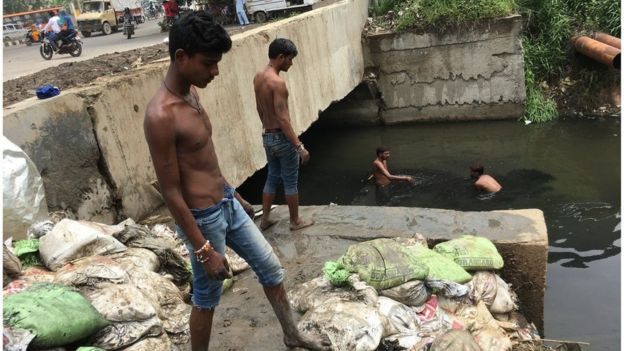
انڈیا کے دارالحکومت دہلی کے ہرن کیدانا علاقے میں بہنے والے نالے میں آس پاس کے مکانات اور کمپنیوں کا انسانی فضلہ اور فیکٹریوں کا کیمیکل جمع ہوتا ہے۔
قریبی سڑک کی خالی جگہ پر نالے سے کئی روز قبل نکالا گيا گندہ کچرا اب سخت ہوگيا ہے۔ اس سے نکلنے والی تعفن اتنا شدید ہے کہ سانس لینا مشکل ہے۔
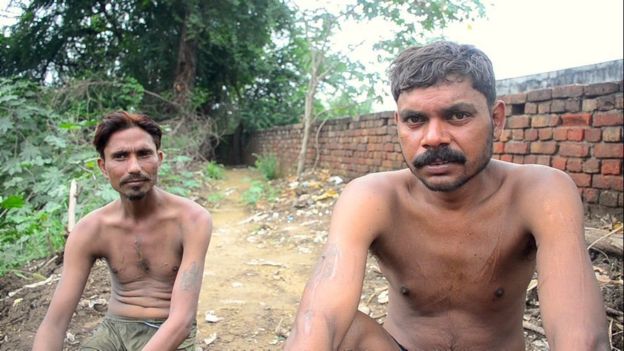
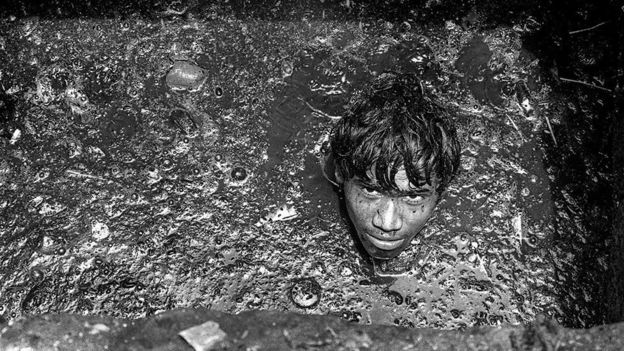
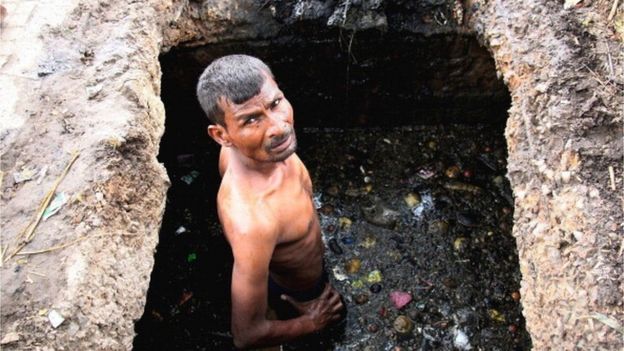
اسی نالے کو صاف کرنے کے لیے نیتو اور اجیت اس کے اندر گردن تک ڈوبے ہوئے تھے۔ کئی بار اس کا پانی ان کی ناک تک چلا جاتا، دونوں نے اپنا منہ زور سے بند کر رکھا تھا۔
ایک کے ہاتھوں میں بانس کی لمبی چھڑی تھی تو دوسرے کے ہاتھوں میں لوہے کا کانٹا جس سے وہ نالے کی تہہ میں پھنسے ہوئے کوڑے کچرے کو ہلانے کی کوشش کر رہے تھے تاکہ وہاں سے پانی کے نکلنے کی جگہ بنے۔
نیتو اور اجیت
Image captionنیتو اور اجیت
نیتو نے اشارہ کیا: 'کالا پانی گیس کا پانی ہوتا ہے، وہی گیس جو لوگوں کی جان لے لیتی ہے۔'
'ہم بانس مار کر دیکھ لیتے ہیں کہ وہاں کوئی گیس موجود ہے کہ نہیں، اور پھر ہم اس میں داخل ہوتے ہیں۔ بندے اس لیے مر جاتے ہیں کیونکہ وہ بغیر اسے دیکھے ہی اس میں کود پڑتے ہیں۔'
ایک دن میں 300 روپے کمانے کے لیے وہ نالے میں پائے جانے والے سانپوں اور مینڈک جیسے جانوروں کی بھی پرواہ نہیں کرتے ہیں۔
دبلے پتلے جانگیا پہنے ہوئے نیتو نالے سے نکل کر دھوپ میں کھڑے ہوئے تو ان کے بدن سے بہنے والا پسینہ اور جسم پر لگا گندہ کیچڑ ایک عجیب سی بو پیدا کر رہا تھا۔
سیور میں پائے جانے والے کانچ، کنکریٹ یا زنگ آلود لوہے سے نیتو کے پاؤں کئی بار زخمی ہوچکے ہیں۔ ان کے پیروں میں ایسے کچھ زخم ابھی بھی تازہ تھے کیونکہ ان کو بھرنے کا موقع نہیں مل پایا۔
خاکروبتصویر کے کاپی رائٹSUDHAKAR OLWAY
ایک غیر سرکاری ادارے 'پریکسس' نے اپنی ایک رپورٹ میں کہا ہے کہ دہلی میں سیور صاف کرنے والے تقریبا 100 خاکروب ہر برس ہلاک ہو جاتے ہیں۔
رواں برس جولائی اور اگست کے محض 35 دنوں میں 10 خاکروب ہلاک ہوئے۔
ایک تنظیم 'صفائی ملازمین اندولن' کے مطابق سنہ 1993 سے انڈيا میں تقریبا 1500 خاکروب ہلاک ہوئے ہیں۔ ادارے نے اس کے دستاویزی ثبوت جمع کیے ہیں اور اس کا کہنا ہے کہ اصل تعداد اس سے کہیں زیادہ ہے۔
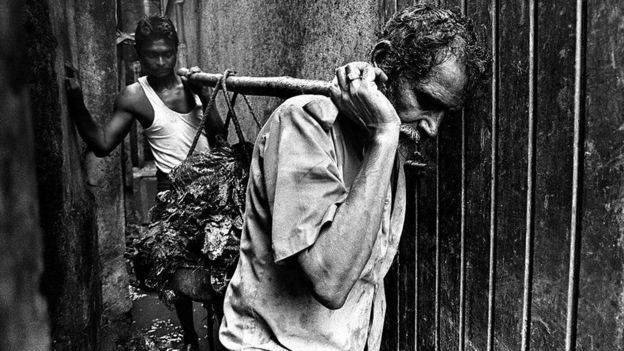
لاکھوں لوگ اب بھی یہ کام کرنے پر مجبور ہیں۔ اس کام سے وابستہ بیشتر افراد کا تعلق دلت سماج سے ہے۔ سیور میں زیادہ تر اموات ہائیڈروجن سیلفائید کی وجہ سے ہوتی ہیں۔
خاکروب
وہ لوگ جو سیور میں کام کرتے ہیں انھیں دمہ، جلد اور پیٹ کی طرح طرح کی بیماریوں کا بھی سامنا کرنا پڑتا ہے۔ نیتو نے یہ کام 16 برس کی عمر سے شروع کیا تھا۔
دہلی میں وہ اپنے بہنوئی درشن سنگھ کی ایک فاسٹ فوڈ کی دکان میں رہتے ہیں۔ انھیں جُھگیوں میں بہت سارے خاکروب ملازمین رہتے ہیں۔
اس کے آس پاس آبادی اتنی زیادہ ہے کہ یہاں سانس لینے کے لیے بہت زور لگانا پڑتا تھا۔ دروازے پر کوڑے کے ڈھیر کو پار کر کے ہم درشن سنگھ کے ڈھابے پر پہنچے۔
درشن سنگھ نے 12 برس تک صفائی کا کام کیا لیکن پاس کی ایک عمارت میں اسی کام کے دوران ان کے دو ساتھیوں کی موت ہوگئی جس کے بعد انھوں نے یہ کام چھوڑ دیا۔
خاکروبتصویر کے کاپی رائٹGETTY IMAGES
انھوں نے بتایا:'ایک اپارٹمنٹ میں ایک پرانا گٹر طویل عرصے سے بند پڑا تھا۔ اس میں بہت گیس تھی۔ ہماری جھگیوں میں رہنے والے دو افراد نے 2000 روپے میں اسے صاف کرنے کا ٹھیکہ لیا تھا۔ پہلے جو بندہ گھسا وہ وہیں رہ گیا کیونکہ گیس بہت بھیانک تھی۔ اس کے بیٹے نے پاپا پاپا کی آواز لگائی۔ پاپا کی تلاش میں وہ بھی اندر گھسا لیکن واپس نہیں آیا۔ دونوں اندر ہی ختم ہو گئے۔ مشکل سے انھیں نکالا گیا۔ تبھی سے ہم نے یہ کام بند کر دیا۔'
قانون کے مطابق ہاتھ سے سیور صاف کرنے کا کام صرف ایمرجنسی کی صورت میں ہی کرنا ہوتا ہے اور اس کے لیے خاکروب ملازمین کی حفاظت کے کئی طرح کا ساز و سامان دینا ہوتا ہے۔ لیکن حقیقت میں بیشتر ایسے ملازمین ننگے بدن کی حالت میں سیور میں کام کرتے ہیں۔
اس طرح کے کام کے دوران ہلاک ہونے کی صورت میں حکومت کی طرف سے متاثرہ خاندان کو 10 لاکھ روپے تک کا معاوضہ دینے کی بھی تجویز ہے۔ لیکن 'آل انڈیا دلت مہاپنچایت' کے مور سنگھ کا کہنا ہے کہ اس کے لیے بہت جد و جہد کرنی پڑتی ہے اور ہر شخص کو ایسی مدد نہیں مل پاتی ہے۔
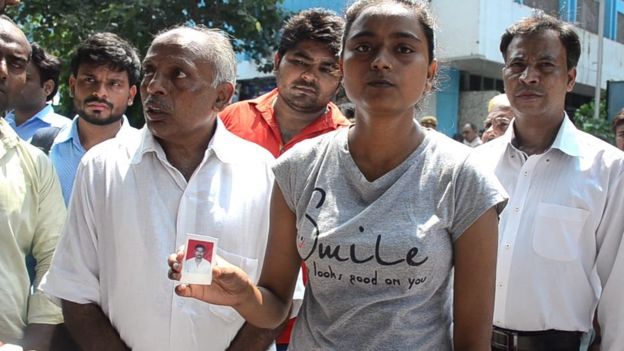
حال ہی میں ایسے ہی ایک واقعے میں دہلی کے لوک جن نائیک ہسپتال کا گٹر صاف کرنے کے دوران 45 سالہ رشی پال کی بھی موت ہو گئی تھی۔
خاکروب
'صفائی ملازمین اندولن' کے بیزواڑا ولسن کہتے ہیں: 'اگر ایک مہینے میں دہلی میں 10 گائیں مر جائیں تو ہنگامہ مچ جائے گا اور لوگ سڑکوں پر نکل آئيں گے۔ اسی شہر میں ایک ماہ میں 10 خاکروب ہلاک ہوئے لیکن ایک آواز نہیں اٹھی۔ ایسی خاموشی روحانی ایذا کا سبب ہے۔'
وہ کہتے ہیں: 'کوئی بھی شخص دوسرے کا پاخانہ پیشاب صاف نہیں کرنا چاہتا لیکن سماجی ڈھانچے کی وجہ سے دلت یہ کام کرنے پر مجبور ہیں۔ جب ہم مریخ پر جانے کے بارے میں سوچ سکتے ہیں تو پھر اس مسئلے سے کیوں نہیں نمٹ پا رہے ہیں۔'
ولسن کے مطابق حکومت لاکھوں نئے بیت الخلا بنانے کی بات تو کرتی ہے لیکن ان کے لیے بنائے جا رہے پٹس یا گڑھوں کو صاف کرنے کے بارے میں کوئی نہیں سوچتا ہے۔
خاکروبتصویر کے کاپی رائٹSUDHAKAR OLWAY
نیتو کے بہنوئی درشن سنگھ کہتے ہیں: 'ہم ان پڑھ ہیں۔ ہمارے پاس کوئی کام نہیں ہے۔ خاندان کو پالنے کے لیے ہمیں یہ کام کرنا پڑتا ہے۔ اگر ہم کسی بند گٹر کے بارے میں سوال کرتے ہیں تو افسر کہتے ہیں، آپ اس میں گھسیں اور ہمیں اپنا پیٹ پالنے کے لیے مجبوراً یہ کام کرنا پڑتا ہے۔'
'کئی بار ہم اپنے بچوں کو نہیں بتاتے کیونکہ یہ گندا کام ہوتا ہے۔ ہم ان سے کہہ دیتے ہیں کہ ہم مزدوری کرتے ہیں۔ ہم سوچتے ہیں کہ اگر ہم نے انھیں سچ بتا دیا تو وہ ہم سے نفرت کرنے لگیں گے۔ کچھ لوگ شراب پیتے ہیں۔ مجبوری میں آنکھ بند کرکے کام کرتے ہیں۔'
'لوگ ہمیں دور سے پانی دیتے ہیں۔ کہتے ہیں، وہاں رکھا ہے، لے لو۔ نفرت بھی کرتے ہیں۔ بہت سے لوگ ہم سے نفرت کرتے ہیں کیونکہ یہ گندا کام ہے۔ ہم اگر نفرت کریں گے تو ہمارا خاندان کیسے چلے گا۔'


Wednesday, August 30, 2017

Trump’s Warning To Islamabad Has Formalised The China-Pakistan-Russia Axis

        
By Kunwar Khuldune Shahid
In calling out the "safe havens for terrorists in Pakistan" as part of his Afghanistan policy, US President Donald Trump has given formal shape to a reality that has been brewing in South Asia since Washington fell out with Islamabad post the Osama bin Laden raid.
With both Beijing and Moscow coming out in Islamabad's defence almost immediately, the China-Russia-Pakistan axis has been formally inaugurated, with the US and India allying in Afghanistan—as epitomised by Trump's call for New Delhi to help out Washington in the region.
Washington and New Delhi have been conspicuously toward drawn each other since the 2008 nuclear deal, a similar version of which Islamabad has been demanding as well. However, initial US policy had been to ensure that proximity with India doesn't alienate its traditional ally Pakistan, which heretofore had a pivotal role for Washington in Afghanistan.

What the Trump regime has done to chastise Islamabad over Afghanistan echoes the Indian stance in the region, specifically targeting Pakistan's "jugular vein": Kashmir.
Following the bin Laden raid, the relations between the US and Pakistan became increasingly acrimonious under the Obama regime. Under the Trump presidency, the Republicans in the Congress that had already been clamouring to revisit aid to Pakistan—asking Islamabad to pay for its F-16s last year, for instance—now have a formal outlet to vent their frustration.
What the Trump regime has done to chastise Islamabad over Afghanistan echoes the Indian stance in the region, specifically targeting Pakistan's "jugular vein": Kashmir.
In little over three months, Trump implicitly equated Kashmir's freedom fight with terrorism at an Islamic summit in Riyadh, sanctioned the Kashmir-bound Hizbul Mujahideen and its commander Syed Salahuddin as terrorists, and now officially underscored the problem of Pakistan "harbouring terrorists" while seeking the solution from India.
Meanwhile, China has continued to forestall New Delhi's move to blacklist Kashmir-bound jihadists at the UN, as it continues work on the $62 billion corridor with Pakistan, while further reigniting its own border dispute with India in Doklam.
Moscow drawing closer to Islamabad, at least militarily, naturally overlapped with US angst vis-à-vis Pakistan. It started with Russia lifting its self-imposed arms embargo on Pakistan in November 2014, following by a landmark "military cooperation" agreementthat culminated in the first ever joint military drill between the two countries last year.
In the meantime, Pakistan will be importing Mi-35 combat helicopters in addition to the Russian Klimov RD-93 engines for its JF-17 multi-role fighters. Moscow and Islamabad have also signed a deal for the construction of the North-South gas pipeline from Karachi to Lahore, to cater to the ever growing energy needs in Pakistan's most populous province.
The shaping of these axes in South Asia has been further facilitated by Indo-Pak ties reaching their nadir amidst increasing volatility in Kashmir.
This formation of hard alliances is a return to 20th century diplomacy and the rigid rulebook that defined bilateral relations, and which caused wars of all kinds.
With the US involved in direct confrontation in Ukraine and the South China Sea, as on-ground samples of its longstanding rivalries with Russia and China, the formalisation of coalitions means the respective alliances could henceforth be backing territorial disputes and regional crises as single units, drawn against one another and overlapping with the security and economic cooperation between the groups.
Even so, Russia cannot overlook the economic power that India is growing into. It is especially unlikely that Moscow would stop its military exports to New Delhi, despite its two-pronged security antagonism with Islamabad and Beijing.
Another promising ally for the China-Russia-Pakistan axis would've been Iran, considering Tehran's proximity to Moscow and bitterness vis-à-vis the US, which has seen it join Beijing and Moscow in condemning Trump's accusations against Islamabad. But Pakistan's own ties with Iran have deteriorated in recent times, with Tehran echoing the US India in accusing Islamabad of providing safe havens to terror groups, and even threatening military invasion inside Pakistani territory.
Furthermore, Pakistan's unflinching obligations to Saudi Arabia, which is the foundation of its differences with Iran, coupled with New Delhi and Tehran's growing economic cooperation along with Kabul—as exemplified by the Chabahar Port—mean that Iran isn't a natural fit for either of the two groups, especially since Washington is unlikely to diplomatically ease things for Tehran under Trump, who has signed a "$110 billion" arms deal with Saudi Arabia.
This formation of hard alliances is a return to 20th century diplomacy and the rigid rulebook that defined bilateral relations, and which caused wars of all kinds. But there still might be a chance that the China-Pakistan-Russia axis might end up being shaped by the common interests that define it, rather than the ramifications for the states that it alienates.
Even so, with stridently antagonistic voices and policymaking now at the helm in Washington and New Delhi, coupled with Islamabad's rigidly masochistic shielding of jihadist groups, it is likely that confrontation rather than cooperation will remain the order of the day in South Asia—at least in the near future.


Trump’s new Afghanistan policy has Pakistan angry and alarmed


By Pamela Constable
ISLAMABAD, Pakistan — A wave of anti-American anger has swept Pakistan this past week, triggered both by President Trump’s threat to punish the country for harboring insurgents and by his invitation to India, Pakistan’s longtime rival, to become more involved in Afghanistan’s future.
Tribal and religious leaders have held protests at border crossings, and banners urging “Say no to America!” have appeared across the capital. Officials have canceled trips to Washington and asked a State Department official to postpone her planned visit here this week. Across the country’s fractious political spectrum, leaders have raised a collective fist at Trump.
In a stern speech Aug. 21, the U.S. president laid out a new militarized policy for the region, saying he would send more American troops to Afghanistan and insisting that Pakistan must “do more” to rein in Islamist militants or face possible sanctions, such as cutting aid or revoking its status as a major non-NATO ally. 

Afghan officials welcomed Trump’s message, but Pakistanis accused him of “bullying” their country despite its history of cooperating with the United States in foreign conflicts. They said he had betrayed them by reaching out to India, which Pakistan views as a persistent threat to its existence. 
“President Trump wants to portray us as a villain despite the huge losses­ we have suffered in the so-called anti-terrorism war,” said Hafiz Hamdullah, a conservative Muslim cleric and legislator. “Both India and the U.S. want to use Afghanistan against us. These charges of terrorist hideouts are just to destabilize Pakistan.”
Mian Raza Rabbani, the left-leaning chairman of Pakistan’s Senate, denounced Trump in similar terms. “No country in the world has done more than Pakistan to counter the menace of terrorism,” he declared. Invoking the “legacy of Vietnam,” he said that if Trump “wants Pakistan to become a graveyard for U.S. troops, let him do so.”
In tribal regions along the border, where U.S. drone strikes have killed hundreds of suspected militants and civilians, one crowd of tribesmen chanted, “Long live Pakistan.” In another spot, religious activists held up placards saying, “India, America and Afghanistan are conspiring against Pakistan.”
Pakistan’s National Security Committee, which comprises top military and civilian officials, sharply rejected Trump’s charges of sheltering insurgents and demanded that the U.S. military “eliminate sanctuaries for terrorists” on the Afghan side. “The Afghan war cannot be fought in Pakistan,” the group declared.
Pakistani officials took other steps to show their unhappiness. They requested that a planned visit by Alice Wells, the senior State Department official dealing with the region, be indefinitely postponed. Pakistan’s foreign minister, who had been planning a trip to Washington, instead announced that he would travel to China, Russia and Turkey. 
Despite the hostile rhetoric, there were signs that U.S.-Pakistan relations are far from collapsing. Over the past few weeks, several low-profile meetings were held between current and former officials from both governments to discuss how to keep relations on an even keel.
Pakistani newspapers ran headlines that blasted Trump as a hectoring bully but also published nuanced commentaries calling for pragmatism and patience. The editors of Dawn, the country’s most influential daily paper, counseled that “there is still space and time for constructive dialog. A strategic rupture is in neither the U.S. nor Pakistan’s interest.”
For Pakistan, the issue of militant sanctuaries is a familiar one; both of Trump’s immediate predecessors pressed Pakistan to crack down on them but did not take harsh measures, especially because Pakistan was cooperating in the broader anti-terrorism war. This time, though, Pakistani officials are said to be far more worried that Trump, an unpredictable leader, may follow through.
“Trump’s threats are real. . . . Madness on our doorstep has already arrived,” commentator Syed Talat Hussain wrote in the News International on Monday. He suggested that if Trump, “an ignoramus addicted to creating sensation,” ordered a drone strike in Pakistani territory — as opposed to the border tribal areas — it could “get us embroiled in a war with the U.S. This is deadly serious business.”


Pakistanis have been even more deeply rattled by Trump’s warm embrace of India, where the current prime minister is an ardent Hindu nationalist and Indian army troops have been waging an aggressive, months-long campaign against Muslim protesters in the disputed Kashmir region.
Pakistan has long pursued influence in Afghanistan largely as a foil to India, a larger and more powerful rival, only to see New Delhi become a major benefactor of the U.S.-backed government in Kabul. 
“Trump’s comments about India were more unsettling for Pakistanis than his threats to Pakistan,” said Michael Kugelman, a Pakistan expert at the Woodrow Wilson International Center for Scholars in Washington. “The U.S. calling for a deeper Indian footprint in Afghanistan sets off alarm bells across Pakistan. It will cause very real fear.”
A few Pakistani voices here have called for a rethinking of Pakistan’s efforts to influence Afghanistan, noting this has created a burden on its resources and a spillover of Islamist radicalization. But virtually no one questions the notion that India, the world’s largest democracy, is their mortal enemy — a premise that has long kept Pakistan’s army in a position of extraordinary power but has left the country increasingly isolated. 
“We have sacrificed for so many years to help the United States, and this Afghan war has destroyed us,” said Rehman Malik, a Pakistani senator and former interior minister. “We don’t want anything but their respect. We are a victim of terrorism, not a cause of it. We want peace in Afghanistan, not war. Now America is befriending India at the expense of Pakistan. And that really hurts.”